

Commuter Students at Howard Left Without a Place to Rest
LIFESTYLE | SEP 15, 2025
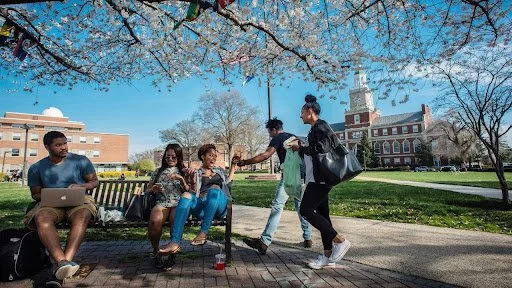
Andre Chung/Washington Post via Getty Images
For most Howard students, long gaps between classes are a chance to nap, grab food, or relax in their dorms. But for commuter students, that’s no longer an option.
Without a place to go during breaks, many commuters are left wandering campus, looking for somewhere to rest, eat, or join an online class. And with more students living off campus due to housing shortages, the problem isn’t going away anytime soon.
“When I lived on campus, I could always go back to my dorm to rest or eat between classes,” said Gabrielle Taylor, a senior biology major.
Gabrielle commutes from College Park and takes a shuttle that runs every 30 minutes. For her 8 a.m. classes, she’s up by 6 a.m. to catch the 7 a.m. shuttle.
“Even when my first class is at 10, I still have to plan everything around the shuttle times,” she said. “By the time I get to campus, I’m already tired.”
“There’s really nowhere on campus for commuters to rest,” she added. “The libraries are the only quiet spaces, but you can’t eat there. If you try to sit in the yard or the valley, it’s loud and crowded with people going to class.”
For commuters, the lack of space affects more than just where to eat or relax. Online classes have made things more frustrating, especially for students stuck on campus with nowhere quiet to go.
“I have an online class at 11 and then an in-person class right after at noon,” said Haylee Gibson, a junior studying criminology and political science. “UGL is too loud, and Founders is so quiet I can’t speak during class. I usually end up in the basement of Locke or Carnegie, which isn’t very convenient.”
Howard does have lounge areas scattered across campus in residence halls, academic buildings, and student centers but students say these spaces are often overcrowded, poorly advertised, or off-limits to those who don’t live on campus.
Even the few common areas open to all students like the Undergraduate Library (UGL), Founders Library, the Health Sciences Library (HSL), or the Blackburn Center are frequently packed, noisy, or not suitable for relaxing or attending online classes.
Faced with limited options, some students have resorted to other workarounds. Clarris Duhaney, a junior biology major, said she still uses her old dorm ID to get into the lounge of her former residence hall.
“It’s one of the few quiet places I can go to rest,” she said. “I’m not really supposed to be there, but it’s better than sitting outside.”
Other universities in D.C. have taken a more intentional approach to commuter support. At George Washington University commuters have access to a dedicated lounge inside the University Student Center. It has a fridge, microwave, and seating where students can rest or study. Run with support from the Commuter Student Association, the lounge gives commuters a reliable place to recharge.
At Howard, students say a space like this would help. Having somewhere quiet to attend virtual classes or have a meal in between their rigorous class schedules would make long days easier and show that the university cares about commuters.
By TATiana traoe
The Latest

TRENDS WE ARE PREDICTING FROM NYFW
BY ARIANA ADADE

5 SUMMER MOVIES TO WATCH WHEN THERE’S NOTHING TO WATCH
BY CORTNEII SAMUEL

THE SUN TRIED TO COOK HOWARD STUDENTS LAST WEEK
BY ASHLEY JOHNSON